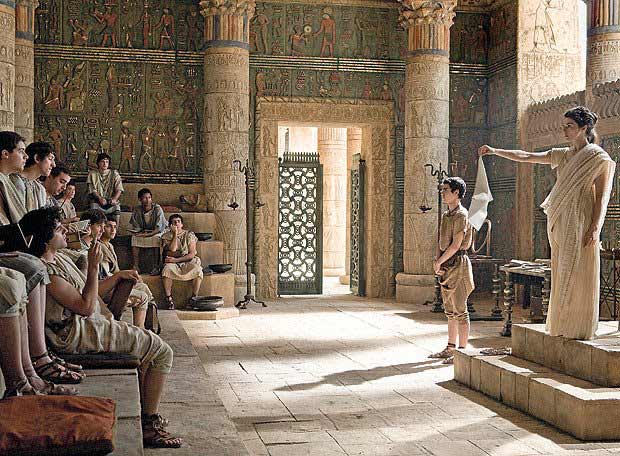
Of course I wanted to see this film as soon as I stumbled upon it on IMDb. It’s set in Ancient Egypt and that was enough for me right there. The fact that it starred Rachel Weisz and Max Minghella were just bonuses really.
***SPOILER ALERT****
I had high expectations of this film, part of a reaction to the nonsensical idiocy that was The Clash of the Titans. I wanted to enjoy an epic that portrayed the ancient world as it was. It hasn’t been a disappointment – I think it’s a must see, simply because of what it portrays. Moreover, the way the film brings Alexandria to life is splendid, though I would have loved to see a scene set in the infamous lighthouse, just for the hell of it.
One thing I will warn others of though is that it is rather a brutal telling of the events surrounding the fall of the Empire and the rise of Christianity within Alexandria, so this isn’t for the faint hearted.
The film follows Hypatia, a philosopher and teacher and it opens with her musing about the force that allows our feet to stay on the ground and brings a cloth floating down; centuries ahead of Isaac Newton we see. She is talking about it with her group of students in the ‘agora’, the Greek word for a place of assembly – think Roman forum. Rachel Weisz is brilliant in the lead role, with a perfect balance of scholarly, wide eyed excitement and heavy eyelids filled with disappointment and veiled horror at what is being allowed to happen in the city. Alongside her story, the story of Alexandria unfolds, where the Christians begin to brazenly mock the previous pagan religions (I despise using the word ‘pagan’, simply because of its connotations; I’d rather use a word that doesn’t denote such disrespect). This incites the followers of the Egyptian religion and so ensues a horrible back and forth which sees the Christian majority driving out the Jews and banning the practice of anything ‘pagan.’ It makes for very uncomfortable viewing. I think I must have had a past life around that era, because the scene where the Christians run into the library – the most famed library in the world at that point, for it held knowledge untold, where Hypatia and her father study - and destroy it and its scrolls, really hit me in the chest. I had to hold back cries of outrage (yes, I know it’s a film but it did happen and the film scores points for being able to pull me in so relentlessly). My heart wept as Hypatia cried over the loss of the library.
Showing posts with label religion. Show all posts
Saturday, 15 May 2010
Thursday, 11 March 2010
'Sacred Hearts' by Sarah Dunant exceeds expectations
I finished reading this book a couple of weeks back and have yet to write a review of my thoughts. So here it will be.
I picked up the book courtesy of the raving compliments the panel from the TV Book Club lavished it with, otherwise it would never have been a book I would have read. The only pulling theme was the idea of sisterhood.
Needless to say, I was entranced from the first few chapters. Sarah Dunant brilliantly weaves a tapestry of the details of convent life without feeling you have necessarily slipped back in time. You appear to be immediately there, within the confined space of this place and whether this in part due to the fact that it is written in the present tense, it achieves the engaging hook.
What's more, I love a book that promises more than it lets on. As Dunant commented herself, the skeletal premise is based around whether or not the new novice to the convent, Serafina, will escape or succumb to accepting being a nun for life. Dunant never allows us to stray far from the turmoil and shocking injustice that Serafina feels at being tricked into the life of the nun; it's not thrown in our faces and the details emerge slowly with only implied hints, yet it underlines the days that roll on by as the novice comes out of her rage; it seeps through the seemingly impenetrable wall of the convent.
The highlight of the book is encompassed in the character of Sister Zuana, the dispensary mistress who unconsciously forms a bond with Serafina, whom she is charged to look after initially. The details of the various healing concoctions and methods of the time, (being 1500s Italy) are meticulously outlined with the same vigour the sister herself employs in her work. Her characters also highlights the dilemma between religion and science and consequently, the humanity that is needed to heal, versus the reserve the life of a nun requires.
The rest of the nuns are as brilliantly painted and there's a sense of madness in the more senior ones, all individual in their own bizarre natures. Despite the camaraderie shown at times, you get a sense that the place is still not inducive to the stability of mind or spirit. Essentially it's a power play that rules the comings and goings.
Lastly, the book's last hundred or so pages are simply riveting. There is a brilliant twist, (though I do not like to use this word)- rather a character defies our expectations, so much so that I was cheering at the book at various intervals. Thank god I was reading it alone otherwise I would have received rather strange looks. The ending is just as brilliant and supremely clever in a Shakespearean stroke of genius (quite literally!)
All this without missing the presence of a male character.
RATING: 9/10 stars.
I picked up the book courtesy of the raving compliments the panel from the TV Book Club lavished it with, otherwise it would never have been a book I would have read. The only pulling theme was the idea of sisterhood.
Needless to say, I was entranced from the first few chapters. Sarah Dunant brilliantly weaves a tapestry of the details of convent life without feeling you have necessarily slipped back in time. You appear to be immediately there, within the confined space of this place and whether this in part due to the fact that it is written in the present tense, it achieves the engaging hook.
What's more, I love a book that promises more than it lets on. As Dunant commented herself, the skeletal premise is based around whether or not the new novice to the convent, Serafina, will escape or succumb to accepting being a nun for life. Dunant never allows us to stray far from the turmoil and shocking injustice that Serafina feels at being tricked into the life of the nun; it's not thrown in our faces and the details emerge slowly with only implied hints, yet it underlines the days that roll on by as the novice comes out of her rage; it seeps through the seemingly impenetrable wall of the convent.
The highlight of the book is encompassed in the character of Sister Zuana, the dispensary mistress who unconsciously forms a bond with Serafina, whom she is charged to look after initially. The details of the various healing concoctions and methods of the time, (being 1500s Italy) are meticulously outlined with the same vigour the sister herself employs in her work. Her characters also highlights the dilemma between religion and science and consequently, the humanity that is needed to heal, versus the reserve the life of a nun requires.
The rest of the nuns are as brilliantly painted and there's a sense of madness in the more senior ones, all individual in their own bizarre natures. Despite the camaraderie shown at times, you get a sense that the place is still not inducive to the stability of mind or spirit. Essentially it's a power play that rules the comings and goings.
Lastly, the book's last hundred or so pages are simply riveting. There is a brilliant twist, (though I do not like to use this word)- rather a character defies our expectations, so much so that I was cheering at the book at various intervals. Thank god I was reading it alone otherwise I would have received rather strange looks. The ending is just as brilliant and supremely clever in a Shakespearean stroke of genius (quite literally!)
All this without missing the presence of a male character.
RATING: 9/10 stars.
Subscribe to:
Posts (Atom)
